Winter boat storage at Lake of the Ozarks: slip, lift, lot or indoors
The trade-offs between leaving a boat in the water or on a lift, storing it outside on land or on a trailer, and paying for indoor storage, plus the questions to ask before you sign a storage agreement.
Before you call
Have the boat's make, model, length and beam, the engine type, and whether it has a trailer. Ask what the storage covers, whether haul-out, transport, winterization and shrink wrap are separate, when you can get to the boat, and what insurance the facility carries and wants from you.
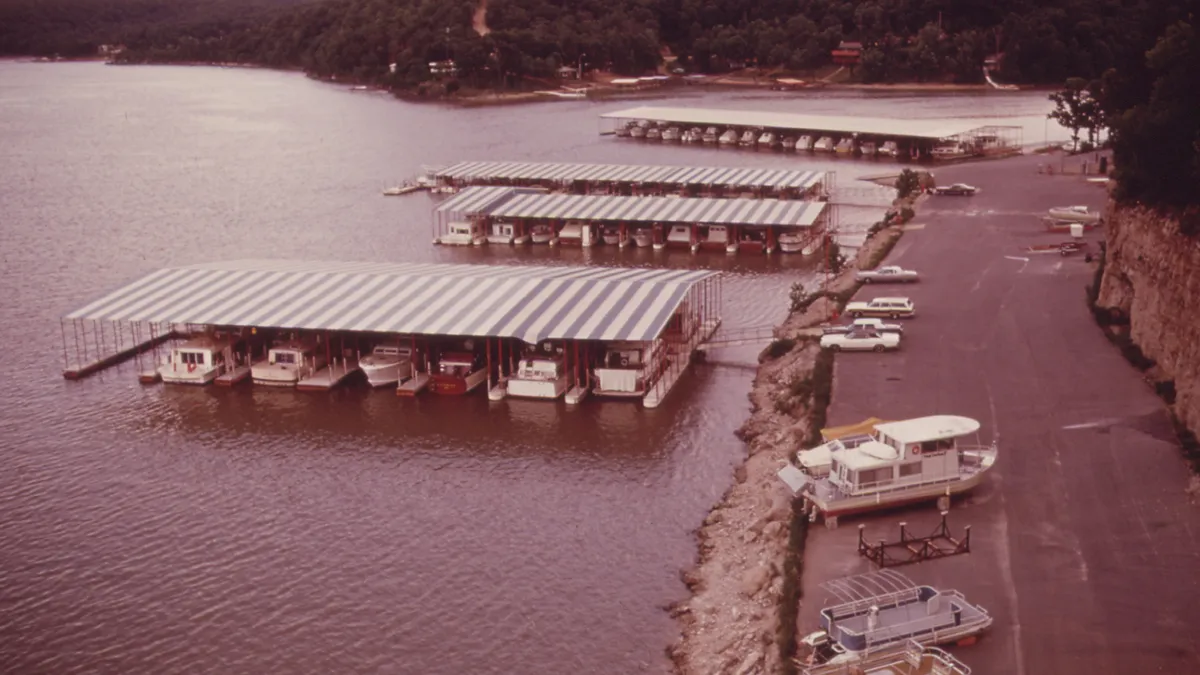
Once the boat is done for the year, it has to spend the winter somewhere. At the Lake the usual choices are leaving it in the slip or on the lift, hauling it out to an outdoor lot or onto its trailer, or paying for indoor storage. None of them is right for every boat. This guide won't tell you which one to pick or what it should cost. It lays out the trade-offs BoatUS describes, what the winter drawdown means for a boat left at the dock, and the questions to ask before you sign anything.
In the slip or on the lift
Leaving the boat at your dock or marina slip skips the haul-out and keeps it close. BoatUS says the trade-off is more exposure: ice, wind, waves and lines all need watching, and a boat in the water has a greater chance of sinking if something fails. If the slip can freeze, BoatUS says you need a dependable bubbler or deicer and enough depth for it to work. At the Lake, Ameren lowers the water every winter, and in December 2025 it said the drawdown would take the Lake to about 654 feet. Depth varies from cove to cove, so check what the drop means at your spot. For a boat on a lift, BoatUS suggests checking the lift cables and fittings, adding dock lines in case the lift drops, securing the boat against wind, and strongly considering storing it ashore instead.
- How much water will be under the boat or lift if the Lake drops a few more feet?
- Does my slip need a deicer, and who checks that it's running?
- Who checks on the boat after wind, snow or ice while I'm away?
- Should the boat come off the lift for the winter?
Outside on land or on the trailer
BoatUS says outdoor storage on land generally costs less than indoor storage, is easier to get to, and leaves room for winter projects. The catch is weather. It needs a strong, breathable, water-resistant cover, ideally on a sturdy frame so it sheds snow and doesn't flap in the wind, and the boat has to be properly blocked and supported. On a trailer, BoatUS says to park away from trees, keep drains clear, pull the bilge plugs and keep the boat somewhere secure. Discover Boating adds that an outdoor lot should be fenced and locked with some form of security.
- Is the lot fenced, locked and watched?
- Who blocks and supports the boat, and can I visit it?
- Will the boat be shrink wrapped or covered, and who does it?
- Is the trailer spot level and away from trees?
Indoor and rack storage
Indoor storage gives the most protection and security, according to BoatUS, and some buildings are heated while others are not. It costs more, access can be limited to business hours, and many facilities restrict or ban owners working on their own boats. BoatUS recommends winterizing even in a heated building in case a storm knocks out the power, and notes that many insurance policies won't cover freeze damage unless the boat was winterized. Its winterizing guide adds that dry storage racks are built for typical hulls and can't always support unusual designs, and that you should ask the facility about its fuel tank rules.
- Is the building heated, and what happens if the power goes out?
- When can I get to the boat, and do I need to call ahead?
- Can I or my own mechanic work on the boat there?
- Will your racks fit my hull, and what are your fuel tank rules?
Compare the same deal
BoatUS says storage is usually priced by length or by length times beam, plus extras like winterization, power and shrink wrap, and can be billed monthly, by the season or by the year. Many marinas bundle storage with haul-out, shrink wrap and winterization. Ask each place for a written list of what's included so you're comparing the same thing, and count the haul-out and transport costs too. BoatUS also suggests visiting a facility before you commit and checking its fire protection and insurance.
- Is storage priced by length or square footage, and is it monthly, seasonal or yearly?
- Are haul-out, launch, transport, winterization and shrink wrap included or separate?
- What insurance do you carry, and what do you require from me?
- Can I see where the boat will sit before I sign?
Common questions
Can I leave my boat in the water all winter at Lake of the Ozarks?
Some owners do. BoatUS says in-water storage means more exposure to ice, wind and waves and a greater chance of sinking if something fails, and a slip that can freeze needs a dependable deicer. Ameren also lowers the Lake each winter, so check how much water will be under the boat at your spot.
Do I still need to winterize if the boat is stored indoors?
BoatUS recommends winterizing even in a heated building in case the power goes out, and says many insurance policies won't cover freeze damage unless the boat was winterized. Check your own policy.
Can Lake Shortlist tell me where to store my boat?
No. We list businesses and the questions worth asking. Contact businesses directly, visit before you sign, and compare written terms before you decide.
Find businesses for this project
Read the stated jobs and service area, then build a comparison of up to three.
A few of the businesses listed in each category, shown in alphabetical order. This is not a ranking or a recommendation.
Marinas & slip rentals
- Big Thunder Marine at Glencove Marina – Service Center
- Buddy's Harbor
- LOTO Marina
- Station 46 Marina
- Village Marina
Boat repair & marine service
- Cool Breeze Marine – The Prop Specialists
- Deer Valley Marine
- Moonlight Yacht & Marine (Ozark Boat Repair)
- Pro Team Marine
- Village Marina
Boat covers, canvas & upholstery
See all 3 listedRelated planning guides
Ready to describe your project?
Describe the work once. Lake Shortlist will review your request and may follow up with you. Your request stays with Lake Shortlist; nothing is automatically sent to a business.
Free to submit. A request does not guarantee a quote or a business’s availability.
Sources & editorial notes
- BoatUS: Winter boat storage options, indoor, outdoor and in-water (October 2026)
Trade-offs of in-water, outdoor, indoor, trailer and lift storage, cover and support advice, the indoor winterization and insurance note, and how storage is usually priced. Checked 2026-11-11.
- BoatUS: The Boater's Guide to Winterizing
Dry storage racks are built for typical hulls, and facilities may have fuel tank requirements. Checked 2026-11-11.
- Discover Boating: boat storage guide
Outdoor storage security and indoor access planning. Checked 2026-11-11.
- Ameren Missouri: dock owners get winter ready as lake levels drop (Dec. 15, 2025)
The 2025 seasonal drawdown to about 654 feet and cove-to-cove depth differences. Checked 2026-11-11.
Checklist questions are our editorial suggestions. This is not a personal-use testimonial, technical design, price quote or finding that any listed business is best. Confirm current requirements and project details directly.
No business paid for inclusion in this guide. Lake Shortlist is operated by Mason Bennett, who also owns Hollerback. Marketing services cannot buy editorial selections. Correction and dispute information.